Choosing the right rack is not simply about filling empty wall or floor space. A small kirana shop, a neighborhood grocery store, a supermarket and a large hypermarket all need different rack configurations.
The right supermarket rack solution depends on the size of the store, the products being displayed, available floor space, storage requirements and how customers move through the shop.
For retailers in Delhi and Delhi NCR, this is particularly important because store formats can vary from compact neighborhood outlets to large-format retail stores.
Retailers planning a complete store setup can also explore our retail display solutions for different business requirements.
What Are Supermarket Rack Solutions?
Supermarket rack solutions are combinations of display racks, shelving units and supporting fixtures selected according to a store’s products and available space.
Instead of using the same rack throughout a shop, retailers can combine different units such as:
- Wall-mounted or wall-side racks
- Gondola racks
- End-cap racks
- Corner racks
- Multi-tier shelving
- Heavy-duty storage racks
- Special-purpose display units
The objective is straightforward: use the available space efficiently while keeping products visible, accessible and properly organized.
Which Rack Solution Is Best for a Kirana Shop?
A kirana shop usually has limited floor space and a large number of product categories. The rack system therefore needs to provide maximum usable storage without making the shop difficult to navigate.
Wall-side racks are useful for grocery items, packaged foods and household products because they make use of the store perimeter. Compact shelving can be used for smaller products, while corner units help utilize areas that might otherwise remain unused.
For a small shop in Delhi, a practical rack arrangement is generally more useful than installing oversized supermarket fixtures.
A good kirana rack setup should provide:
- Adjustable shelves for different package sizes
- Easy access to frequently purchased products
- Good visibility from the customer side
- Sufficient load capacity
- Efficient use of wall and corner space
For smaller stores working with limited budgets, affordable display racks for small shops can be a practical option.
What Racks Work Well for Grocery Stores?
Grocery stores normally have more floor space than traditional kirana shops and carry larger product ranges. This allows retailers to use a combination of wall racks and centre gondola racks.
Gondola racks can divide the sales floor into product sections while allowing customers to browse from both sides. Wall racks are useful around the store perimeter, particularly for products that require continuous shelving.
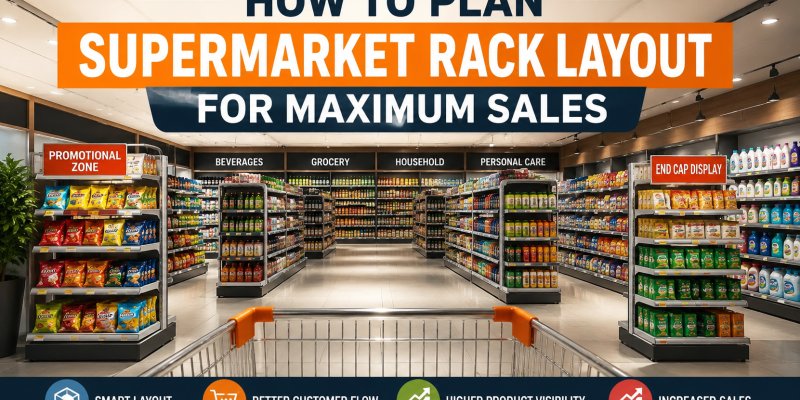
End-cap displays can then be positioned at the ends of aisles for selected products or promotional merchandise.
This combination gives grocery retailers more flexibility than relying on a single rack type.
How Should Supermarket Racks Be Selected?
For a supermarket, rack selection should start with the product mix and store layout, not with the rack appearance alone.
A supermarket carrying packaged groceries, personal-care products, cleaning supplies and household goods may need several shelving configurations.
Before selecting racks, consider:
- Available floor area – Measure the usable selling space before deciding rack dimensions.
- Product weight – Heavier products require appropriate shelf and frame capacity.
- Product size – Adjustable shelving is useful when package sizes vary.
- Customer movement – Aisles need enough clearance for comfortable shopping.
- Product visibility – Frequently purchased and promotional products should be easy to see.
- Future changes – Modular racks are useful when product categories change over time.
The best rack system is therefore not necessarily the largest or most decorative one. It is the one that fits the store’s operating requirements.
Retailers looking for a dedicated range of supermarket display racks can explore our supermarket display rack solutions
What Is an End-Cap Rack Used For?
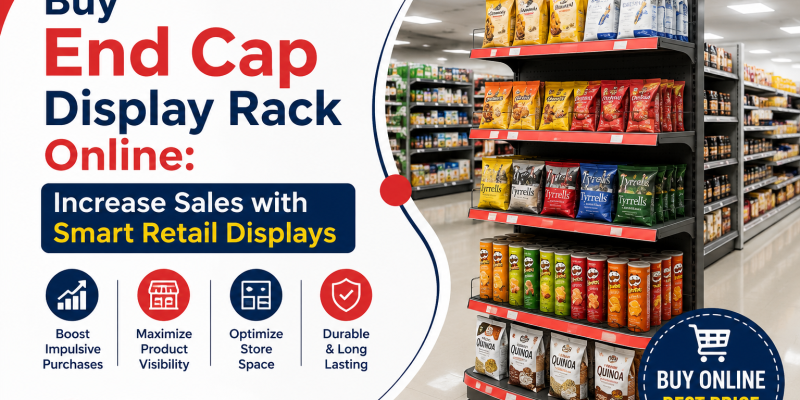
An end-cap rack is positioned at the end of a shelving aisle. It provides a separate display area that can be used for selected products, seasonal merchandise or promotional offers.
Because shoppers naturally encounter the end of an aisle while moving through a store, end-cap space can be valuable for products that need additional visibility.
For supermarkets and larger grocery stores, end-cap racks can complement the main gondola shelving rather than replacing it.
How Are Rack Solutions Different for Hypermarkets?
Hypermarkets require a different approach because they handle larger product volumes and much greater customer traffic.
A large-format store may need:
- Heavy-duty gondola shelving
- High-capacity storage systems
- Wall-side display racks
- End-cap displays
- Dedicated category fixtures
- Back-of-store storage solutions
The important point is coordination. In a hypermarket, racks need to work as part of the overall store system rather than as individual pieces of furniture.
Product categories, aisle planning, stock replenishment and customer movement all influence the final rack configuration.
How Can Delhi Retailers Choose the Right Rack Configuration?
Retailers in Delhi and Delhi NCR should evaluate the store before selecting a rack system.
A simple assessment can include:
Store size → product categories → product weight → storage requirement → customer movement → rack configuration
For example, a compact grocery outlet may benefit more from wall racks and space-efficient shelving, while a larger supermarket may require gondola racks, end-cap displays and additional storage capacity.
Local availability can also matter when racks need to be delivered, installed or modified according to site conditions.
Why Is Adjustable Shelving Useful in Retail Stores?
Adjustable shelving allows the distance between shelves to be changed according to the products being displayed.
This is useful for retailers because product packaging is rarely uniform. A rack designed only for one shelf height can create wasted vertical space when product sizes change.
Adjustable shelves allow the same rack to accommodate different categories over time, making the display system more practical for changing retail inventories.
What Should You Check Before Ordering Supermarket Racks?
Before placing an order, check the following:
- Rack height, width and depth
- Shelf adjustment options
- Load capacity
- Material and finish
- Available colours and configurations
- Floor-space requirements
- Installation requirements
- Number of racks required
- Scope for future expansion
Do not select racks only because they look good in photographs. The dimensions and load requirements need to work with the actual store.
For retailers comparing available options, you can also explore supermarket display racks designed for organized product presentation.
Supermarket Rack Solutions for Different Store Sizes
| Store type | Main requirement | Suitable rack approach |
|---|---|---|
| Kirana shop | Maximum use of limited space | Wall, corner and compact shelving |
| Grocery store | Organized product categories | Wall + gondola + end-cap racks |
| Supermarket | Flexible product presentation | Gondola + wall + promotional displays |
| Hypermarket | High capacity and large-scale organization | Heavy-duty + gondola + specialized fixtures |
The exact combination should still be decided according to the store’s dimensions, products and operating requirements.
Frequently Asked Questions
Which rack is best for a small grocery shop?
For a small grocery shop, wall-side and compact adjustable racks are generally practical because they use the available space efficiently without occupying too much floor area.
Are gondola racks suitable for supermarkets?
Yes. Gondola racks are commonly useful where products need to be displayed on both sides of a central aisle. They can help divide a supermarket into organized product sections.
What is the purpose of a supermarket end-cap rack?
An end-cap rack creates additional display space at the end of an aisle. It can be used for selected, seasonal or promotional produc
Should supermarket racks have adjustable shelves?
Adjustable shelves are useful when a store carries products with different package heights. They also make it easier to modify the display when the product mix changes.
How do I choose racks for a store in Delhi?
Start with the store’s measurements, product categories, expected load, available aisle space and storage requirements. Then select a combination of racks that fits the actual premises rather than choosing solely on appearance.
Can the same rack system be used in a kirana shop and a hypermarket?
Not necessarily. Both stores have different space, capacity and merchandising requirements. A compact configuration may work for a kirana shop, whereas a hypermarket normally needs a more extensive combination of display and storage systems.
Final Takeaway
There is no single rack configuration that works equally well for every retail store.
Kirana shops need space-efficient shelving. Grocery stores need organized category displays. Supermarkets need flexible gondola and wall-rack combinations. Hypermarkets need higher-capacity systems planned around large-scale operations.
For retailers in Delhi NCR, the right solution should be based on the actual store dimensions, product range and expected usage. Selecting racks this way creates a cleaner shopping environment while making better use of the available retail space.