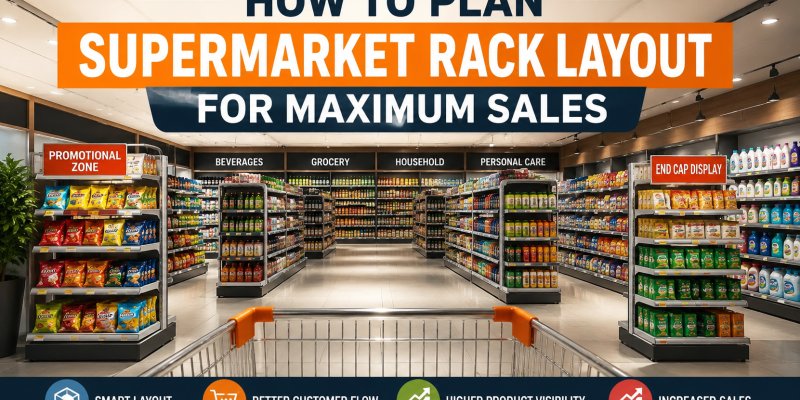
Walk into any well-run supermarket in India—whether it’s a neighbourhood kirana in Lajpat Nagar or a large-format hypermarket in Gurgaon—and you’ll notice one thing immediately: the racks just feel right. The aisles are easy to navigate, products are visible at a glance, and you don’t feel cramped or overwhelmed. That ‘feeling right’ is no accident. It’s the result of carefully chosen MS supermarket display rack sizes aligned with the store layout, product mix, and customer movement patterns.
Yet rack sizing is one of the most overlooked decisions in Indian retail store planning. Many store owners purchase racks based on price alone—or simply replicate what they’ve seen elsewhere—without considering how the dimensions will interact with their specific floor plan. The result? Overcrowded aisles, poor product visibility, understocked shelves, or wasted floor space. All of these directly hurt sales per square foot.
In this guide, Bharat Display Solution—a leading supermarket rack manufacturer in Delhi with over a decade of experience supplying PAN India—breaks down everything you need to know about MS supermarket display rack size selection. From standard dimensions to product-specific recommendations, aisle planning to common mistakes, this is the definitive sizing guide for Indian retail.
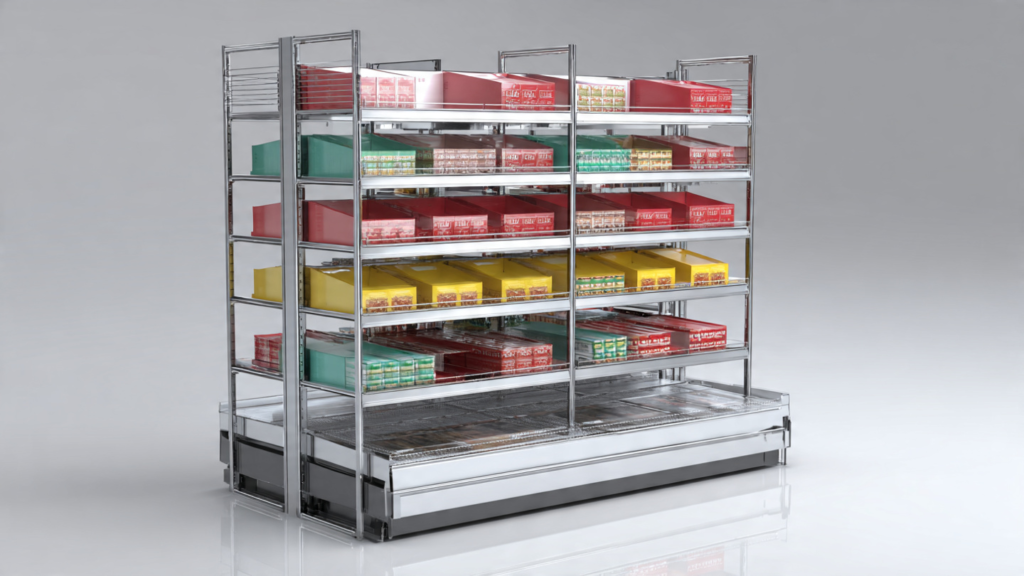
Why Rack Size Matters in Supermarket Layout Planning
Choosing the wrong display rack dimensions doesn’t just affect how your store looks—it affects how your store performs. Here’s why getting the size right is critical:
1. Customer Navigation & Dwell Time
- Oversized racks in narrow stores create bottlenecks and frustrate shoppers.
- Undersized racks in large stores leave too much dead space, reducing perceived value.
- Correctly sized racks guide customers through natural flow zones, increasing dwell time and impulse purchases.
2. Product Visibility & Planogram Efficiency
- The right rack height ensures products at eye level (900mm–1500mm zone) receive maximum attention.
- Incorrect shelf depth leads to products either getting hidden at the back or falling forward, both damaging to sales.
- Good rack sizing supports efficient planogramming, letting you merchandise more SKUs per linear meter.
3. Space Utilisation & Revenue per Sq. Ft.
- In Indian retail, real estate costs are significant. Every square foot must earn its keep.
- Taller racks maximise vertical space in stores with higher ceilings.
- Gondola racks of the right depth allow more products without creating dangerous overstock conditions.
4. Inventory Capacity & Restocking Cycles
- Larger depth racks (350–400mm) hold more stock, reducing restocking frequency—critical for high-volume FMCG.
- Smaller depth racks (250mm) suit cosmetics, pharma, or confectionery where frequent rotation matters.
Standard MS Supermarket Display Rack Sizes in India
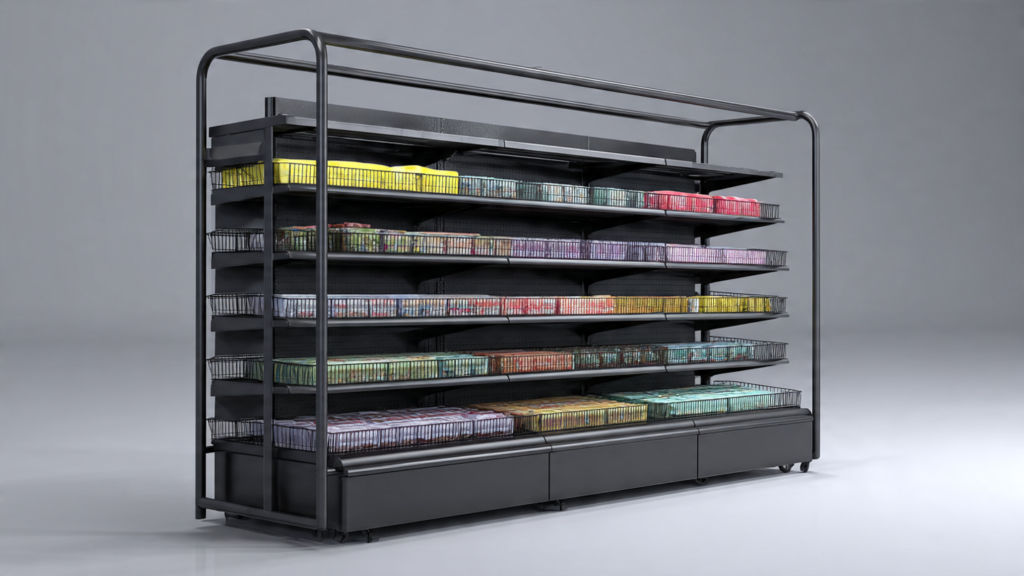
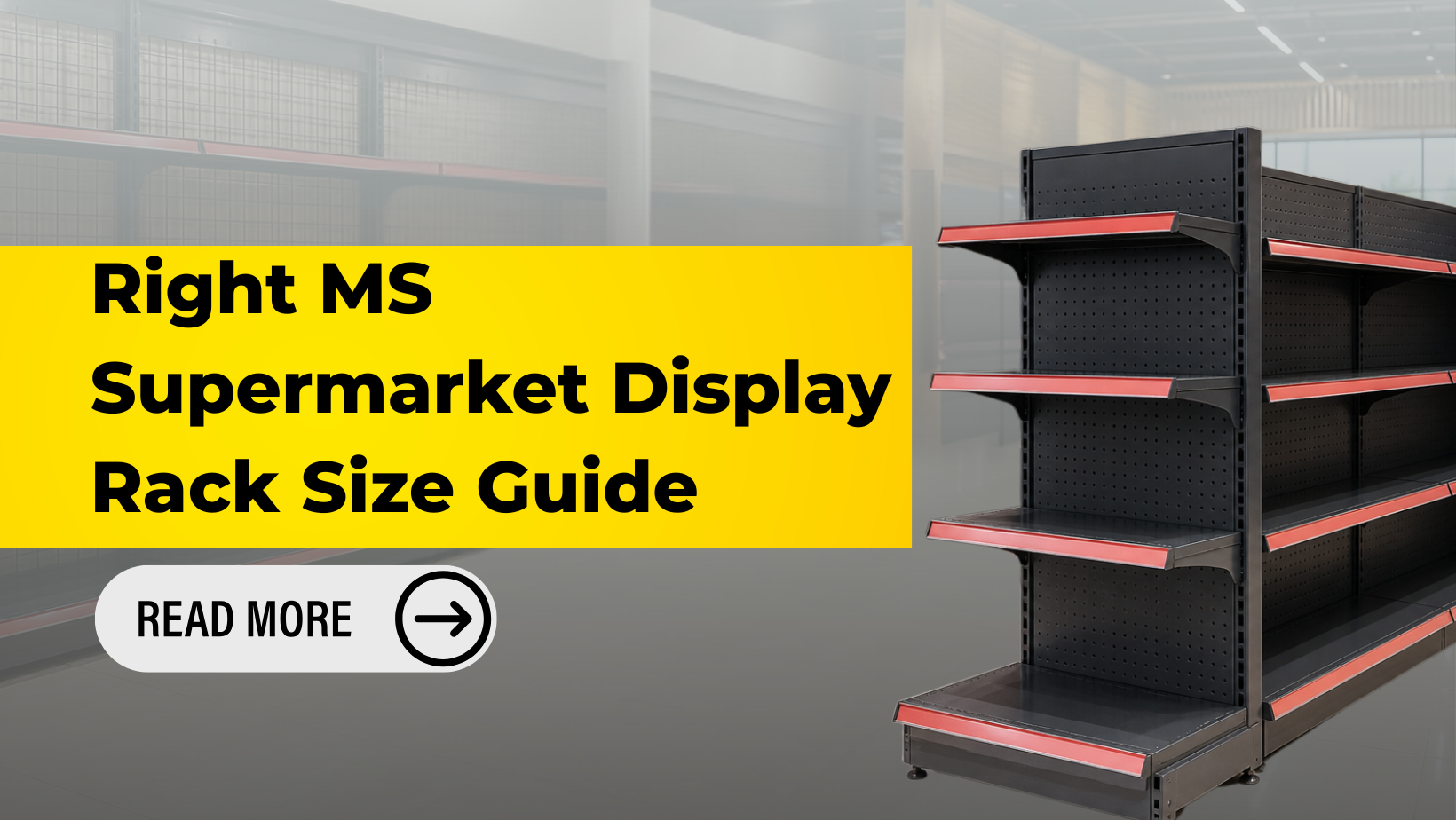
As one of the most trusted supermarket rack manufacturers in Delhi, Bharat Display Solution works with a wide range of standard dimensions—while also offering full customisation. Here are the industry-standard display rack dimensions used across Indian supermarkets: MS Supermarket Display Rack
| Dimension | Options Available | Common Use | Notes |
| Height | 1500mm / 1800mm / 2100mm / 2400mm | All store types | 2100mm most popular in India |
| Width (Bay) | 600mm / 900mm / 1000mm / 1200mm | Grocery, FMCG | 900mm is standard bay width |
| Depth (Single Side) | 250mm / 300mm / 350mm / 400mm | Cosmetics to groceries | 300–350mm suits most categories |
| Depth (Double Side) | 500mm / 600mm / 700mm / 800mm | Central gondola runs | 600mm most common for gondola |
Single-Sided vs. Double-Sided (Gondola) Racks
- Single-sided wall racks: Typically 300–400mm deep, placed against walls. Ideal for perimeter merchandising.
- Double-sided gondola racks: 600–800mm deep, freestanding in the centre of the store. Maximize floor area utilisation in medium and large supermarkets.
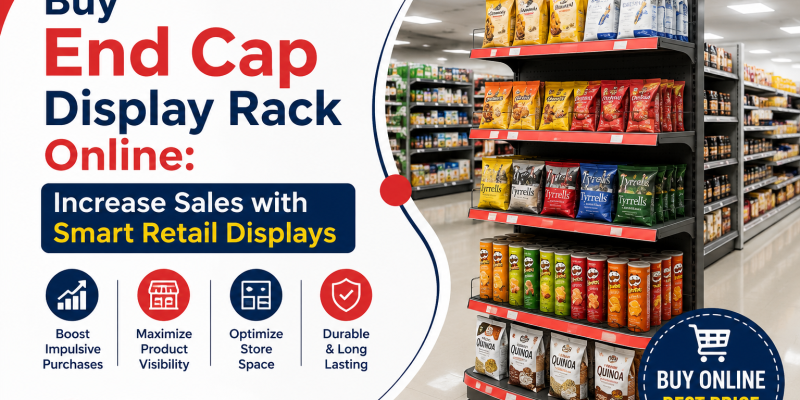
- End cap/gondola-end racks: Typically 600mm deep × 900mm wide, placed at aisle ends for promotional display. MS Supermarket Display Rack
How to Choose Rack Size Based on Store Area
Your store’s total floor area is the single most important factor in determining which rack dimensions to select. Here’s a practical framework used by experienced retail designers:
Small Kirana / Minimart (Up to 500 sq. ft.)
- Recommended rack height: 1500mm–1800mm (avoid taller racks that make the store feel claustrophobic)
- Bay width: 600mm–900mm to fit within tight layouts
- Depth: 250mm–300mm single-sided wall racks; avoid double-sided gondola racks unless the floor allows ≥3m aisle width
- Shelf count: 4–5 shelves per bay works best for small-format grocery
- Tip: Use wall-mounted perimeter racks and a central 2-3 gondola run to maximise selling area
Medium Grocery Store (500–2000 sq. ft.)
- Recommended rack height: 1800mm–2100mm for good product capacity
- Bay width: 900mm–1000mm (standard bay width that suits most gondola systems)
- Depth: 300mm single-sided for wall runs; 600mm double-sided for central gondola rows
- Shelf count: 5–6 shelves per bay; add a base deck shelf for heavy items
- Plan for 2–4 gondola rows depending on store width; maintain minimum 1.2m aisles
Large Supermarket / Hypermarket (2000+ sq. ft.)
- Recommended rack height: 2100mm–2400mm to exploit high ceilings and maximise vertical merchandise density
- Bay width: 1000mm–1200mm for wider product facing
- Depth: 350–400mm single-sided; 700–800mm double-sided gondola
- Multiple gondola runs with 1.5m–2m wide aisles for trolley movement
- Invest in end-cap gondola racks for promotional displays at aisle ends
Related Resource: Before finalising your rack plan, check out our detailed MS Supermarket Display Rack Buying Guide for a complete overview of material grades, load capacities, and finishing options.
Rack Size Selection by Product Category
Different product categories have fundamentally different dimensional requirements. Using a one-size-fits-all approach is one of the biggest mistakes Indian store owners make. Here’s how to match rack dimensions to product types:
Grocery & Staples (Pulses, Rice, Flour)
- Depth: 350mm–400mm (packaged staples are bulky)
- Height: 1800mm–2100mm with reinforced base shelf for heavy 5kg–10kg bags
- Use MS racks with minimum 80–100kg load capacity per shelf
- Shelf spacing: 300mm–400mm between shelves for tall packaging
FMCG & Packaged Foods
- Depth: 300mm–350mm (standard FMCG packs fit well)
- Height: 2100mm with 5–6 shelf levels; eye-level shelves (900–1500mm) are prime real estate for top-selling SKUs
- Bay width: 900mm–1000mm per bay for efficient planogramming
Heavy Products (Edible Oils, Beverages, Cleaners)
- Depth: 400mm to accommodate larger containers
- Shelf load rating: 100kg+ per shelf; use heavy-duty MS construction with upright thickness ≥ 1.5mm
- Limit height to 1800mm for safety (avoid top-heavy stacking of heavy units)
- Base shelf: Use solid base shelf (not wire mesh) for stability
Cosmetics & Personal Care
- Depth: 250mm–300mm (small packaged items don’t need deep shelves)
- Height: 1500mm–1800mm; lower racks improve visibility of small products
- Consider glass-front display variants for premium cosmetics in high-end retail
- Shelf spacing: 200mm–250mm between levels; add price tag strips and dividers
Crockery & Utensils
- Depth: 350mm–450mm for plates, bowls, and cookware
- Height: 1800mm maximum (heavy items should not be displayed too high)
- Shelf pitch: 250mm–350mm; use slotted uprights for flexible adjustment
- Ensure base shelf load capacity of 150kg+
Snacks, Confectionery & Impulse Items
- Depth: 250mm–300mm; smaller packs need less depth but more facing
- Height: 1500mm–1800mm; keep snacks at eye and grab level
- Best positioned near billing zones and store entry for maximum impulse purchasing
- Use narrow bay widths (600–900mm) for high-turnover snack racks near checkout
Ideal Aisle Space and Rack Spacing Guidelines
Even the best rack dimensions fail if aisle planning is poor. This is the most underestimated aspect of retail store shelving size planning in India. MS Supermarket Display Rack
Recommended Aisle Widths
- Minimum aisle width (pedestrian only): 900mm–1050mm — suitable only for very small kirana formats
- Standard aisle width (single trolley): 1200mm–1400mm — adequate for medium grocery stores
- Comfortable aisle width (dual trolley pass): 1800mm–2100mm — recommended for large supermarkets
- Premium aisle (hypermarket standard): 2400mm+ display rack
Customer Movement Considerations
- Plan a clear ‘racetrack’ or perimeter path around the store that naturally guides customers past all product zones.
- Keep main arteries (entry to exit) at least 1.5m wide at all times.
- Avoid dead-end aisles—they frustrate customers and reduce dwell time.
- In stores with children’s or toy sections, widen aisles to 1.8m+ to accommodate trolleys and prams.
Billing Zone Spacing
- Allow 1200mm–1500mm between the last gondola row and the billing counter.
- Place low-height snack/impulse racks (900mm–1200mm) adjacent to the billing zone.
- Ensure billing staff have clear sightlines across the store for loss prevention.
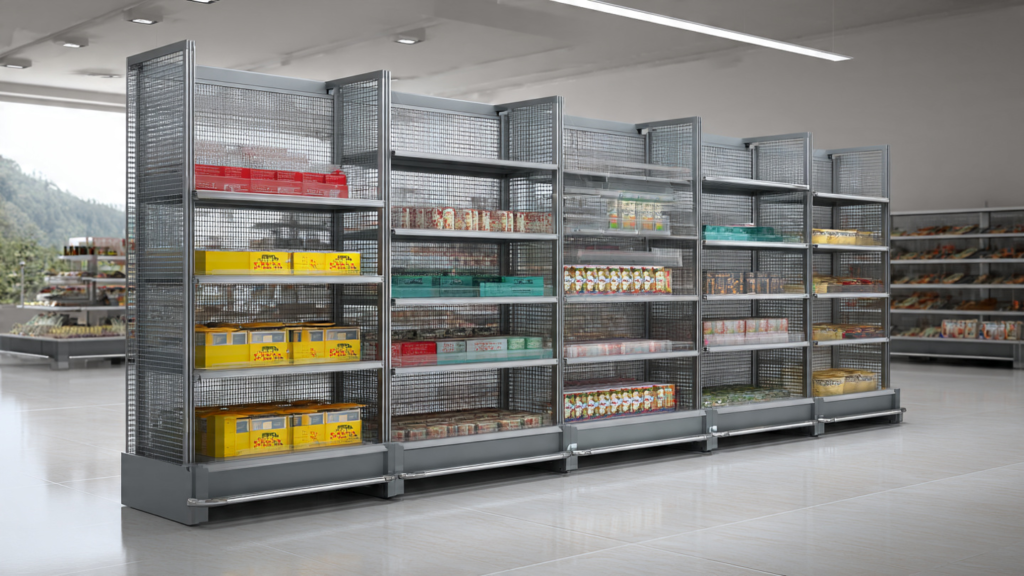
Common Mistakes to Avoid When Selecting Rack Size
Based on hundreds of installations across Delhi, NCR, and PAN India, here are the most frequent rack sizing errors that cost store owners money:
- Buying oversized racks for a small store: 2400mm racks in a 400 sq. ft. store create a ‘tunnel’ effect, making customers uncomfortable and reducing browsing. Always match rack height to ceiling height and store format.MS supermarket display rack size
- Ignoring ceiling height: The industry rule is to maintain 300mm–500mm clearance between the top of the rack and the ceiling for lighting efficiency and air circulation. Fire suppression systems (sprinklers) also need clearance under NBCI norms.MS supermarket display rack size
- Wrong depth selection for categories: Placing cosmetics on 400mm deep shelves wastes space and makes products look lost. Using 250mm shelves for packaged rice results in dangerous product overhang. Match depth to product dimensions.display rack
- Poor aisle planning: Installing racks first and then measuring aisles leads to non-compliant, cramped layouts. Always plan aisle widths first, then fit racks within the remaining space.
- Uniform rack sizing throughout the store: Not all zones serve the same purpose. Wall perimeter racks, central gondola racks, end-cap racks, and checkout racks each have different optimal dimensions. Avoid the common mistake of ordering identical sizes for all positions.
- Skipping a site survey before ordering: Structural columns, HVAC ducts, electrical conduits, and drainage points all affect rack placement. A professional rack manufacturer will conduct a site survey before recommending dimensions.MS supermarket display rack size
Also See: Our comprehensive MS Supermarket Display Rack Product Range — explore all rack types, load capacities, and finishing options available from Bharat Display Solution.
Why Choose Bharat Display Solution for Custom Rack Sizing
When it comes to precision-engineered MS racks built for the Indian retail environment, Bharat Display Solution stands apart from generic rack suppliers. Here’s why hundreds of store owners across India trust us:
Manufacturing Expertise You Can Rely On MS supermarket display rack size
- Over a decade of experience manufacturing supermarket display racks for diverse Indian retail formats—from neighbourhood kirana stores to large modern trade outlets.
- In-house production ensures quality control at every stage: cutting, welding, powder coating, and assembly.
- All racks manufactured with IS-standard MS (Mild Steel) with load-rated shelves—no compromise on safety or durability. MS Supermarket Display Rack
Full Customisation for Every Store Type
- Custom heights (any dimension from 1200mm to 2700mm), widths, and depths tailored to your floor plan.
- Bespoke colour options including powder coat finishes in 50+ standard shades to match your brand palette.
- Add-on accessories: price tag strips, dividers, LED shelf lighting, pegboard panels, grid panels, and more.
- Modular design: racks can be extended, reconfigured, or repurposed as your product mix evolves.
Delhi-Based Manufacturing, PAN India Delivery
- Our manufacturing facility in Delhi gives clients in NCR the advantage of fast turnaround and easy site visits.
- We supply to retail stores across India—from Jammu & Kashmir to Tamil Nadu—with packed, labelled delivery for easy site assembly.
- Bulk order discounts and flexible payment terms for large-scale supermarket projects.
- Post-installation support and warranty on all manufacturing defects.
Frequently Asked Questions
Q1: What is the standard height of a MS supermarket display rack in India?
The most commonly used height is 2100mm, which balances product capacity with customer accessibility. Smaller stores use 1800mm racks, while large supermarkets with higher ceilings opt for 2400mm. At Bharat Display Solution, we manufacture racks from 1200mm to 2700mm in height.
Q2: What rack depth should I choose for a grocery supermarket?
For standard grocery and FMCG products, a 300mm–350mm depth on single-sided racks and 600mm–700mm for double-sided gondola racks is ideal. For heavy products like cooking oil or beverages, increase depth to 400mm for single-sided and 800mm for gondola racks.
Q3: How much aisle space should I leave between racks?
The minimum recommended aisle width in an Indian supermarket is 1200mm for a single-trolley pass and 1800mm for comfortable dual-trolley movement. For large supermarkets and hypermarkets, 2100mm aisles are standard. Never go below 900mm even in small-format stores.
Q4: Can I get custom-sized MS racks for my oddly shaped store?
Yes. Bharat Display Solution specialises in custom rack fabrication. Whether you have irregular store dimensions, structural columns in awkward positions, or specific load requirements, we design and manufacture racks to fit your exact space. Contact us for a free consultation and site measurement.
Q5: How many racks do I need for a 1000 sq. ft. grocery store?
A rough guideline for a 1000 sq. ft. store: 6–8 gondola bays (double-sided, 900mm wide each) for the central area, plus 12–16 wall rack bays around the perimeter. This varies based on aisle width, product range, and layout design. Bharat Display Solution offers free store layout planning assistance with every bulk rack order.
Ready to Plan Your Supermarket Rack Layout?
Get a FREE store layout consultation and custom rack sizing recommendation from our expert team.
Call / WhatsApp: Contact us | Fill This Form our team Connect you shortly : Enquire Now