Buying supermarket display racks involves more than comparing prices or choosing an attractive design. The right racks should fit your store, support the products you sell, make products easy to access, and leave enough space for customers and staff to move comfortably.
This supermarket display rack buying checklist explains what to check before placing an order, including rack material, load capacity, dimensions, rack types, shelf adjustability, surface finish, store layout, customization, pricing, and delivery. Use it to compare suppliers and make a more informed purchasing decision.
Whether you are opening a new supermarket, expanding a grocery store, or upgrading an existing retail space, checking these factors in advance can help you avoid unsuitable dimensions, insufficient shelf capacity, and unnecessary layout changes.
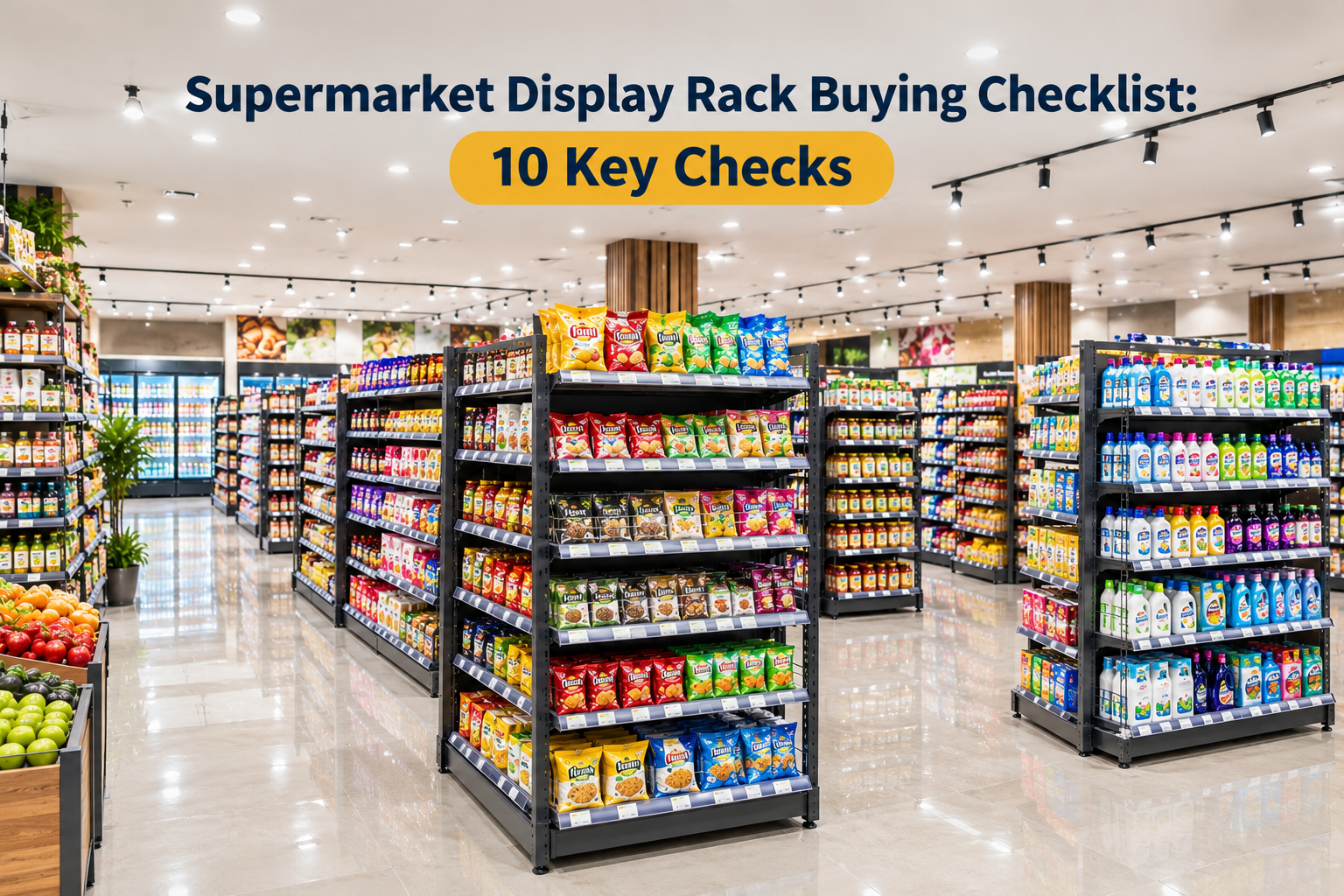
Supermarket Display Rack Buying Checklist: 10 Key Checks
Before ordering, review these ten factors with your supplier.
- Rack material and construction: Confirm the material, frame construction, shelf design, and overall stability.
- Shelf load capacity: Check the specified load capacity for each shelf and the complete rack configuration.
- Rack dimensions: Measure the required height, width, depth, and available floor space.
- Rack type: Decide whether wall-mounted, centre, end-cap, corner, or another configuration suits your products.
- Shelf adjustability: Check whether shelf levels can be changed to accommodate different product sizes.
- Surface finish: Review the coating, finish quality, and suitability for your store environment.
- Store layout: Plan aisle clearance, customer movement, product visibility, and checkout access.
- Customization: Confirm available sizes, shelf configurations, accessories, and design options.
- Total project cost: Compare specifications, quantities, transportation, installation, and other applicable charges.
- Delivery and after-sales support: Confirm delivery timelines, installation responsibilities, warranty terms, and available support.
Keep this checklist while discussing your requirements with potential suppliers. Ask for written specifications and compare quotations based on the same requirements.
Supermarket Display Rack Buying Checklist: Comparison Table
Use this table to review the essential purchasing factors and the questions you should ask before confirming your order.
| Buying factor | What to check | Question to ask the supplier |
| 1. Material and construction | MS steel specifications, frame construction, shelf structure, joints, and stability | What material and construction specifications are provided for these racks? |
| 2. Shelf load capacity | Rated load per shelf, load distribution requirements, and rack configuration | What is the specified load capacity per shelf, and under what conditions does it apply? |
| 3. Rack dimensions | Height, width, depth, shelf dimensions, and available floor space | Can you provide exact dimensions and a drawing of the proposed rack? |
| 4. Rack type | Wall display racks, centre or gondola racks, end-cap units, and corner racks | Which rack types suit my products and store layout? |
| 5. Shelf adjustability | Adjustable shelf levels, product height, shelf depth, and compatible accessories | Can the shelf levels be adjusted for different product sizes? |
| 6. Surface finish | Powder-coated finish, coating consistency, visible defects, and maintenance | What finish is available, and how should it be maintained? |
| 7. Store layout | Customer movement, aisle clearance, checkout access, product visibility, and replenishment space | Can the proposed layout accommodate the available space and required access routes? |
| 8. Customization | Custom rack sizes, shelf configurations, colours, and accessories | Can the racks be customized to match my store measurements and product requirements? |
| 9. Total project cost | Rack quantity, specifications, accessories, customization, transport, installation, and applicable taxes | Does the quotation include all applicable costs, and which services are charged separately? |
| 10. Delivery and support | Production timeline, delivery arrangements, installation, warranty terms, and after-sales support | What are the delivery timelines, installation arrangements, and applicable support terms? |
Buying tip: Compare quotations using the same rack dimensions, material specifications, load requirements, finish, quantity, and delivery conditions. This makes it easier to evaluate the actual value of each offer rather than comparing prices alone.
1. Check the Material and Construction Quality
Material and construction affect the stability, durability, and suitability of supermarket display racks. Metal racks, including mild steel (MS) steel options, are commonly used in supermarkets and grocery stores because they can be configured for different products and store layouts.
Before buying, inspect the following:
- Frame construction and material specifications.
- Shelf material, shape, and supporting structure.
- Joints, connectors, brackets, and other load-bearing components.
- Stability of the assembled rack.
- Quality of fabrication and finishing.
- Availability of replacement shelves or compatible components, where required.
Do not judge rack quality by appearance alone. Ask the supplier to specify the material and construction details in the quotation. If the racks will hold heavier packaged goods, cans, bottles, or bulk products, confirm that the proposed design is suitable for the intended use.
2. Confirm the Shelf Load Capacity
Load capacity is one of the most important checks when choosing supermarket display racks. A rack that looks sturdy may not necessarily be suitable for every product or loading arrangement.
Ask your supplier to clarify:
- The rated load capacity of each shelf.
- Whether the stated capacity assumes an evenly distributed load.
- The recommended load for the complete rack or bay.
- Any restrictions relating to shelf configuration or installation.
- Whether additional support is required for the intended application.
Estimate the expected weight of the products you plan to display. A shelf holding packaged snacks has different requirements from one holding large bottles, cans, or bulk grocery products.
Important: Do not assume a universal load capacity for all supermarket racks. The safe working load depends on the specific design, components, installation, and loading conditions. Obtain the applicable specifications from the manufacturer and follow its loading instructions.
3. Measure Rack Dimensions Before Ordering
Incorrect dimensions can waste valuable floor space or make products difficult to access. Measure your store before finalizing the rack configuration.
Record these measurements:
- Available wall length and floor area.
- Required rack height, width, and depth.
- Ceiling height and any obstructions.
- Doorways, pillars, counters, and electrical panels.
- Space required for replenishing products.
- Clear customer pathways and access to exits.
Also consider the size of the products you intend to display. Tall packages, large containers, and bulky products may require different shelf spacing or depth.
When comparing rack dimensions, make sure you are comparing the same measurement points and configurations. Ask for a drawing or layout plan if the project includes multiple rack rows or custom sizes.
For more information about arranging racks within a retail space, see our supermarket rack layout guide.
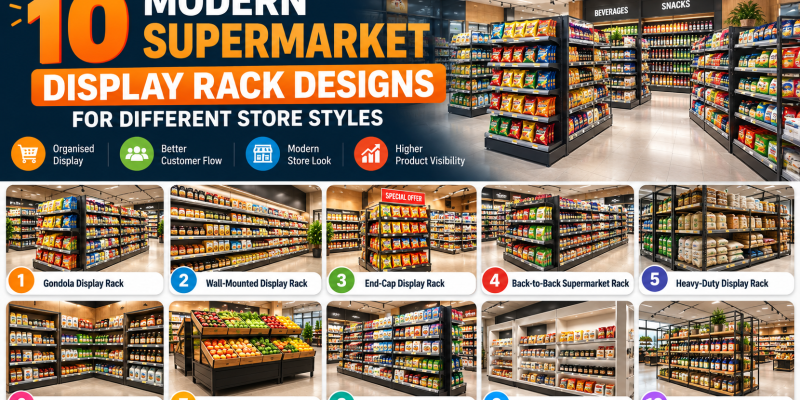
4. Choose the Right Rack Type for Your Store
Different rack configurations serve different purposes. The best option depends on your available space, product categories, shopping flow, and merchandising requirements.
Wall Display Racks
Wall display racks use perimeter wall space and can be useful for displaying packaged groceries, household products, personal care items, and other retail goods.
Before ordering, measure the available wall area and check the required shelf depth, height, product access, and configuration.
Centre Display Racks
Centre display racks, often configured as double-sided gondola units, can display products from both sides of an aisle. They are useful when the store has sufficient floor space for rack rows and customer movement.
Before selecting centre racks, consider aisle clearance, shelf access, visibility across the store, and replenishment space.
End-Cap Display Racks
End-cap racks are positioned at the ends of suitable display rows. They can provide additional visibility for selected products, promotional items, or seasonal merchandise.
Check the dimensions and compatibility with the main rack system before placing an order.
Corner and Specialized Display Racks
Corner racks and other specialized configurations can help use irregular or underutilized areas. Their suitability depends on the store layout and the dimensions of the products being displayed.
When researching the types of racks in retail stores, compare each option according to its purpose rather than choosing based on appearance alone. A combination of rack types may work better than using one configuration throughout the store.
Explore our supermarket display rack options for product-specific information.
5. Check Shelf Adjustability and Product Compatibility
A supermarket may stock products of different heights and packaging sizes. Adjustable shelves can make it easier to change the display when product ranges or merchandising requirements change.
Before buying, check:
- Whether shelf heights can be adjusted.
- Available shelf depth and width.
- Compatibility with your product dimensions.
- Whether shelf dividers, front lips, hooks, or other accessories are available.
- How easily shelves can be repositioned according to the manufacturer’s instructions.
For example, small packaged products may need a different shelf arrangement from large bottles or tall household containers. Plan the configuration around your actual product range instead of assuming that one shelf arrangement will suit everything.
6. Inspect the Surface Finish
The surface finish affects the rack’s appearance and can influence how well it performs in the intended environment.
Powder-coated steel racks are a common option for retail displays. When comparing finishes, ask about the coating process, finish consistency, and care instructions.
Check the following:
- Whether the coating is even across visible surfaces.
- Whether there are obvious scratches, peeling areas, or unfinished edges.
- Whether components fit together without damaging the finish.
- What cleaning and maintenance methods the supplier recommends.
- Whether the proposed finish suits your store environment.
Do not assume that all coated racks have identical corrosion resistance or durability. Ask for the relevant product specifications and warranty terms, if applicable.
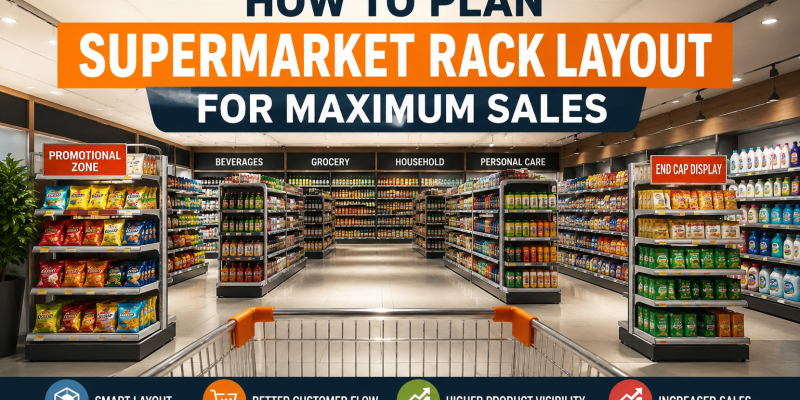
7. Plan the Store Layout and Customer Movement
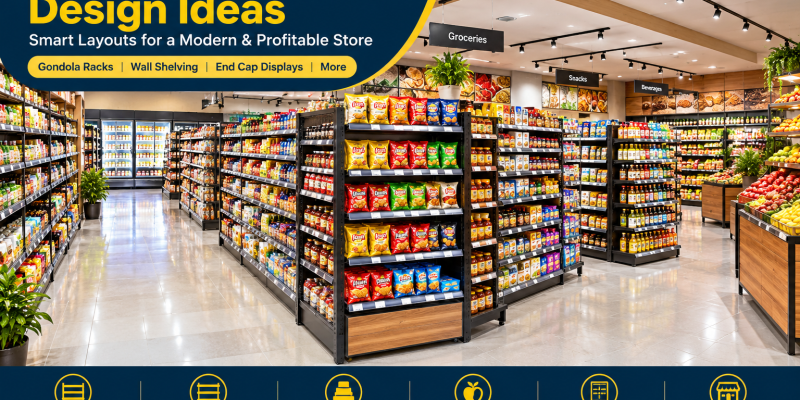
Even well-constructed racks may not work effectively if the store layout is poorly planned. The rack arrangement should support product visibility, easy navigation, replenishment, and safe movement.
Before finalizing the order, consider:
- Clear and convenient entrance and exit routes.
- Appropriate aisle widths for your store and customer needs.
- Visibility of product categories and important signs.
- Access to counters, checkout areas, and frequently purchased items.
- Space for staff to replenish shelves.
- Areas for promotional displays, where appropriate.
- Accessibility and applicable safety requirements.
For small supermarkets, kirana stores, or compact grocery shops, carefully measuring the available floor space is especially important. Avoid filling every available area with racks if doing so makes shopping or replenishment difficult.
The best supermarket rack dimensions and layout depend on the shape of the premises, product range, customer flow, and local safety requirements. Do not rely on a generic layout without checking the actual site measurements.
For more guidance on arranging rack rows and product placement, read our supermarket rack layout guide.
8. Ask About Customization and Accessories
Standard rack sizes may suit some stores, while others need a customized configuration. Before placing an order, explain your product categories, available space, and display requirements to the supplier.
Ask whether the following options are available:
- Custom rack height, width, or depth.
- Different shelf configurations.
- Wall and centre rack combinations.
- End-cap or corner units.
- Product-specific hooks, dividers, or other compatible accessories.
- Colour and finish options.
- Layout drawings or other planning support, if offered.
Customization should solve a specific requirement. Unnecessary modifications can increase project costs or complicate future replacement of components.
Confirm the final design and specifications in writing before production begins.
9. Compare the Total Project Cost
The lowest quoted price does not always represent the best overall value. Two suppliers may quote different products, dimensions, materials, finishes, or included services.
For a fair comparison, check whether each quotation specifies:
- Rack dimensions and configuration.
- Material and construction details.
- Shelf load capacity.
- Number of racks, bays, and shelves.
- Surface finish and accessories.
- Customization charges, if applicable.
- Transportation and delivery charges.
- Installation charges, if applicable.
- Taxes and other applicable costs.
- Warranty and after-sales terms, where provided.
Request an itemized quotation wherever possible. This helps you identify differences between offers and understand the total project cost before making a decision.
If you are purchasing racks for several outlets or a large supermarket, compare the specifications and total cost for the complete requirement rather than comparing individual rack prices in isolation.
10. Confirm Delivery, Installation, and After-Sales Support
Your purchasing decision should also account for how the racks will reach the store and be installed.
Before confirming the order, ask the supplier:
- What is the expected production and delivery timeline?
- How will the racks be packed and transported?
- Is installation included, or must it be arranged separately?
- What site preparation is required before delivery?
- Are assembly instructions provided?
- What warranty, replacement, or after-sales support terms apply?
- Who should be contacted if a component is missing or damaged?
Get the agreed specifications, delivery schedule, payment terms, and applicable support conditions in writing.
For large projects, confirm site measurements and the final layout before production to reduce the risk of costly changes.
How to Choose Supermarket Display Racks for Your Store
Once you have completed the checklist, match the rack configuration to your store’s actual needs.
| Store requirement | What to evaluate |
| Small grocery store | Available wall space, compact dimensions, product access, and aisle clearance |
| Medium-sized supermarket | Wall racks, centre racks, product category planning, and replenishment access |
| Large supermarket | Consistent rack specifications, multiple rack rows, layout planning, and project-wide cost |
| Heavy or bulky products | Verified shelf load capacity, suitable construction, and manufacturer guidance |
| Frequently changing product ranges | Adjustable shelves and compatible accessories |
| Irregular floor plan | Custom dimensions, corner configurations, and a measured layout |
Use this comparison as a starting point, not as a fixed rule. The right rack system depends on your premises, products, budget, and operational requirements.
Common Mistakes to Avoid When Buying Supermarket Racks
A few checks can help prevent common purchasing problems.
Choosing racks based only on price: Compare specifications and total project cost before deciding.
Ignoring measurements: Confirm rack dimensions and aisle clearances using actual site measurements.
Assuming all racks have the same load capacity: Request product-specific load specifications.
Selecting the wrong rack configuration: Match wall, centre, end-cap, and specialized units to the intended location.
Overlooking installation and delivery: Clarify which services and charges are included in the quotation.
Ordering without confirming the final design: Approve the dimensions, configuration, and other specifications before production.
Ignoring future maintenance: Ask about replacement components, cleaning instructions, and applicable support terms.
Frequently Asked Question
What should I check before buying supermarket display racks?
Check material and construction, shelf load capacity, rack dimensions, rack type, shelf adjustability, surface finish, store layout, customization options, total cost, and delivery and installation arrangements. Request written specifications before placing an order.
How do I choose the right supermarket display rack?
Start by measuring your store and identifying the products you need to display. Then compare suitable rack configurations, dimensions, shelf capacity, finish, and total cost. Select a system that meets your operational requirements and allows customers and staff to move comfortably.
What types of racks are used in retail stores?
Common configurations include wall display racks, centre or gondola racks, end-cap racks, corner racks, and specialized product display units. The appropriate combination depends on the store layout, product categories, available space, and merchandising needs.
Why are rack dimensions important in supermarket design?
Rack dimensions determine how much floor space the display occupies and how products fit on the shelves. Incorrect measurements can reduce aisle clearance, limit access, and make replenishment difficult. Measure the premises and planned product range before finalizing the design.
Is MS steel suitable for supermarket display racks?
MS steel is commonly used for metal retail display racks. Its suitability depends on the rack’s design, material specifications, construction, finish, and intended load. Ask the manufacturer to confirm that the proposed rack meets your requirements.
Should I choose wall-mounted or centre display racks?
Wall-mounted racks use perimeter wall space, while centre racks can display products on both sides of an aisle. Many stores use a combination of configurations. Choose according to the floor plan, product range, available aisle space, and access requirements.
What affects the price of supermarket display racks?
Price can depend on rack dimensions, material specifications, construction, number of shelves, finish, accessories, customization, order quantity, transportation, and installation. Compare itemized quotations based on the same specifications.
Should I ask for a store layout before ordering racks?
For projects involving several rack rows, limited floor space, or customized dimensions, a measured layout can help identify potential space and access issues before production. Confirm whether the supplier offers layout planning and what measurements or drawings are required.
Final Buying Checklist Before You Place an Order
Use this final checklist to confirm that your requirements are clear.
- Store measurements have been checked.
- Rack type and quantity have been finalized.
- Material and construction specifications are documented.
- Shelf load capacity has been confirmed.
- Shelf dimensions and adjustability suit the products.
- Finish and accessories have been agreed upon.
- Aisle clearance and access routes have been reviewed.
- Customization requirements are documented.
- The quotation includes applicable additional charges.
- Delivery, installation, and after-sales terms are clear.
- The final design and specifications have been approved
Discuss Your Supermarket Display Rack Requirements
Planning a new supermarket or upgrading an existing store? Share your store dimensions, product categories, approximate rack quantity, and delivery location with Bharat Display Solutions to discuss suitable rack configurations and request a quotation.
Explore our supermarket display rack options for product-specific information, or read our supermarket rack layout guide when planning your store arrangement.