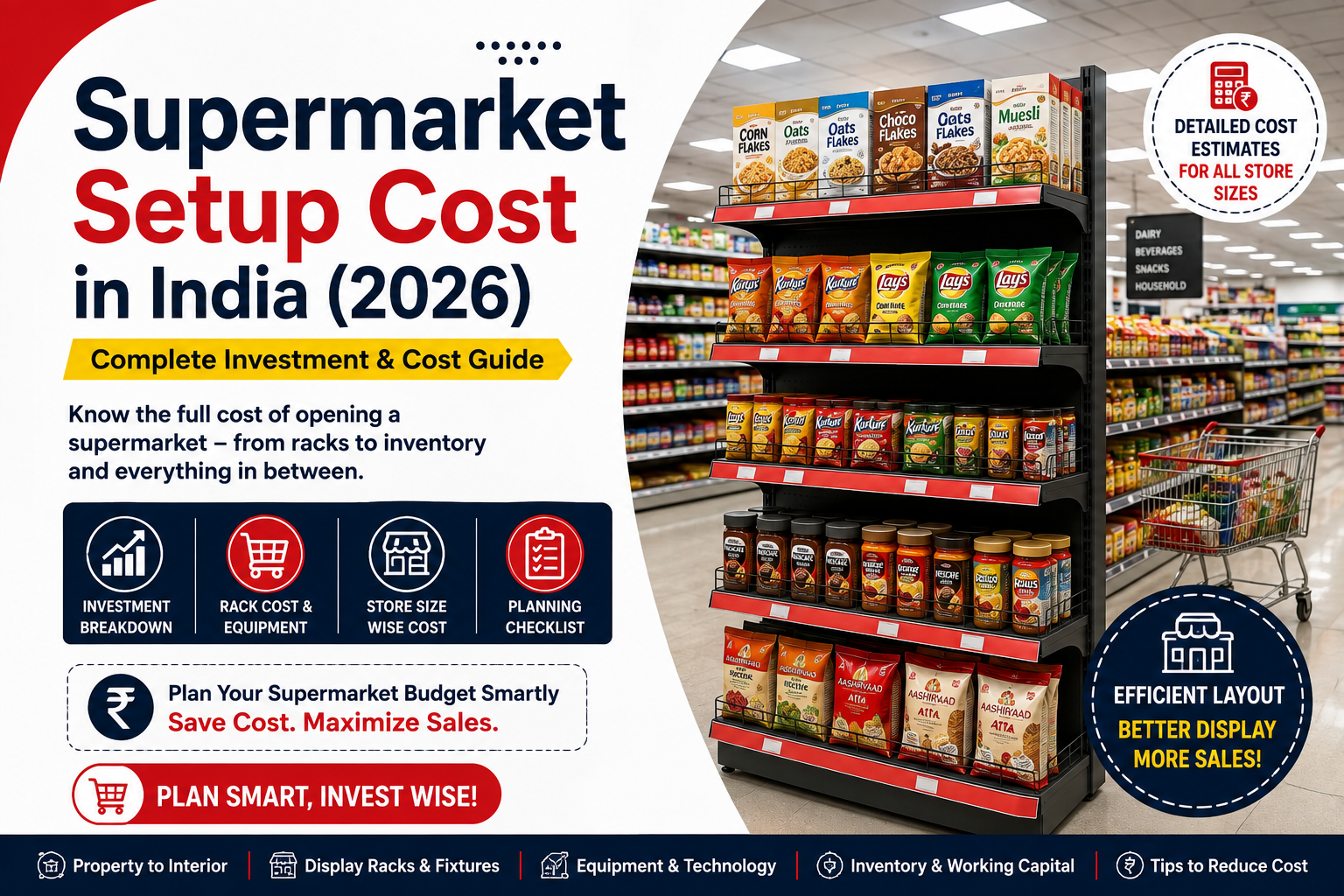
If you are planning to open a supermarket in India, one of the first questions you will probably ask is: How much does it cost to set up a supermarket?
The answer depends on much more than the shop’s rent. A complete supermarket setup may include the property deposit, interiors, supermarket display racks, billing counters, POS software, refrigeration, shopping trolleys, CCTV, lighting, signage, initial inventory, staff and working capital.
For a small supermarket of around 500–1,000 sq. ft., the initial investment may start at approximately ₹5 lakh, while a 1,000–2,000 sq. ft. supermarket can require around ₹10–25 lakh. A larger 2,000–5,000 sq. ft. store may require ₹20–50 lakh or more, depending on its location, product range, infrastructure and inventory.
These figures are indicative rather than fixed prices. A supermarket in Delhi NCR, for example, can have very different property and operating costs from a similar-sized store in a smaller city.
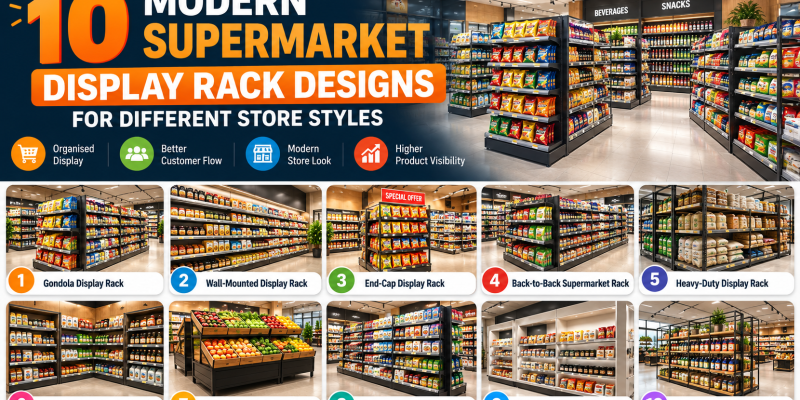
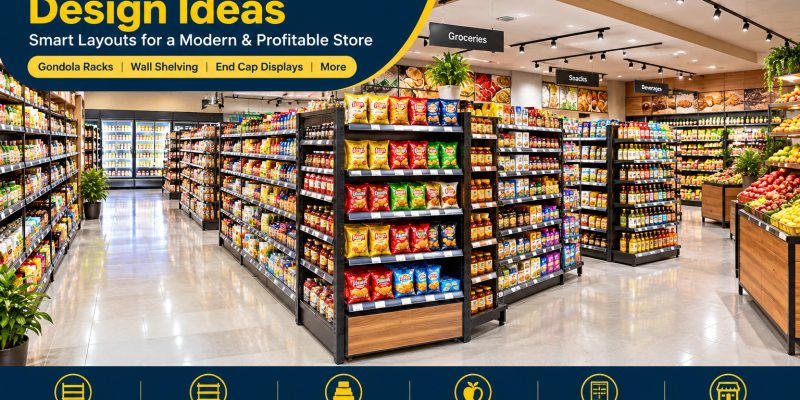
The other major consideration is how you use your available floor space. A supermarket is not simply a room filled with shelves. The arrangement of wall racks, center gondola racks, end-cap displays, aisles, billing counters and promotional areas can directly influence the shopping experience and the amount of merchandise you can display.
Quick Answer: What Is the Supermarket Setup Cost in India?
The approximate initial investment for setting up a supermarket can be broadly estimated as follows:
| Supermarket Size | Approximate Initial Investment |
|---|---|
| 500–1,000 sq. ft. | ₹5–15 lakh+ |
| 1,000–2,000 sq. ft. | ₹10–25 lakh+ |
| 2,000–5,000 sq. ft. | ₹20–50 lakh+ |
| 5,000+ sq. ft. | ₹50 lakh–₹1 crore+ |
These figures should be treated as planning ranges, not quotations.
The actual cost can change based on:
- City and location
- Monthly rent
- Security deposit
- Store size
- Interior specifications
- Number of display racks
- Rack material and load capacity
- Initial inventory
- Refrigeration
- Number of billing counters
- Staff requirements
- Branding and marketing
- Working capital
For this reason, it is better to prepare a complete project budget before purchasing racks, equipment or inventory.
What Does It Cost to Start a Supermarket in India?
A supermarket startup normally consists of several different investments rather than one single expense.
You need to think about the business in four broad stages:
Property → Store Infrastructure → Merchandise & Equipment → Working Capital
Property gives you the space, infrastructure makes it functional, racks and equipment make products sellable, and inventory gives customers something to buy.
A typical setup may include:
- Shop rent and security deposit
- Interior and electrical work
- Supermarket display racks
- Billing counters
- POS and barcode systems
- Refrigerators and freezers
- Shopping baskets and trolleys
- CCTV and security
- Lighting
- Signboard and branding
- Initial inventory
- Storage
- Staff
- Licences and registrations
- Launch marketing
- Working capital
The mistake many first-time supermarket owners make is concentrating almost entirely on inventory and rent while underestimating the infrastructure required to operate the store efficiently.
1. Shop Rent and Security Deposit
Property is usually one of the first major expenses.
The cost of renting a supermarket location varies considerably according to the city and locality. A shop on a busy main road with high visibility and strong footfall will generally have different rental economics from a store located inside a residential market.
Before finalising a property, consider more than just rent.
Look at:
- Local population
- Residential density
- Daily footfall
- Parking availability
- Road visibility
- Accessibility
- Existing supermarkets
- Nearby grocery stores
- Competition
- Customer purchasing power
Your initial property expense may include:
Security Deposit + Advance Rent + First Month’s Rent
If you spend too much of your available capital on the property, you may have less money available for inventory and working capital. Therefore, property selection should be based on the expected business opportunity, not just prestige of the location.
2. Supermarket Interior Setup Cost
Once the property is finalised, the next step is preparing the store.
Supermarket interior expenses may include:
- Flooring
- Ceiling
- Painting
- Electrical wiring
- Lighting
- Billing counter
- Entrance
- Product signage
- Storage area
- Promotional areas
The interior budget can vary significantly depending on whether you want a basic functional supermarket or a premium retail environment.
For a new supermarket, functionality should generally come before unnecessary decoration.
Customers need:
- Clear visibility
- Easy navigation
- Proper lighting
- Comfortable aisles
- Well-organised products
- Easy access to billing
A practical layout can often provide more value than spending a large amount on decorative interiors.
3. Supermarket Display Rack Cost
After the property and basic infrastructure, display racks become one of the most important investments in the store.
Your racks are responsible for displaying products, organising categories and using the available floor area efficiently.
The cost of supermarket display racks depends on:
- Height
- Width
- Number of shelves
- Steel/material specification
- Shelf load capacity
- Thickness
- Powder coating or finish
- Single-sided or double-sided construction
- Accessories
- Quantity
- Customisation
For a detailed understanding of different rack types, their applications and buying considerations, you can also refer to this complete guide to supermarket display racks.
The important point is that there is no universal “supermarket rack price”. A small wall unit, a heavy-duty gondola system and a customised supermarket shelving project will have different costs.
Which Display Racks Are Required for a Supermarket?
Most supermarkets use a combination of different shelving systems rather than one rack type throughout the store.
Wall-Mounted Display Racks
Wall-mounted racks are generally positioned around the perimeter of the store.
They are useful for products such as:
- Packaged food
- FMCG products
- Grocery items
- Household products
- Personal care products
Using the wall area effectively allows the central floor space to remain available for customer movement and gondola racks.
If you want to understand the buying factors, dimensions and applications of this type of shelving, see this wall-mounted display rack buying guide.
For businesses specifically looking for a product solution, the wall mount display rack page provides a more commercial route.
Center Display and Gondola Racks
Center racks are placed in the middle of the supermarket and normally provide shelving on both sides.
They are useful because they create defined shopping aisles while offering a large amount of product display space.
For example, grocery, snacks, beverages, packaged food and household categories can be organised into different aisles.
You can explore the center display rack option when planning this part of your store.
The important thing is not simply to maximise the number of center racks. You must leave enough space for customers and shopping trolleys to move comfortably.
End-Cap Display Racks
End caps are positioned at the end of gondola aisles.
They are valuable because customers can see these displays while moving through the store.
End caps can be used for:
- Promotional products
- Discount offers
- Seasonal merchandise
- New products
- High-margin products
- Fast-moving products
If your supermarket uses promotions regularly, end-cap displays can become an important part of the merchandising strategy.
You can see the commercial application of an End cap display rack and also learn more about buying an end cap display rack online before finalising your requirement.
How Much Does a Supermarket Display Rack Cost?
The cost of a supermarket rack cannot be accurately determined from store size alone.
Two stores of 2,000 sq. ft. can require completely different rack budgets because their product categories, aisle layouts, shelf heights and load requirements may differ.
For example, a store selling mostly lightweight packaged products may require a different shelving specification from one displaying heavy grocery products.
The major pricing factors include:
| Rack Factor | Why It Matters |
| Rack dimensions | Determines material and display area |
| Shelf quantity | More shelves require more material |
| Load capacity | Heavy-duty shelving may require stronger construction |
| Material thickness | Influences strength and durability |
| Finish | Affects appearance and protection |
| Accessories | Additional components affect the final cost |
| Quantity | Larger projects require more units |
| Customisation | Special dimensions can change manufacturing cost |
If you are comparing quotations, don’t compare only the final number.
Ask every supplier to specify:
- Rack dimensions
- Shelf dimensions
- Number of shelves
- Material specification
- Load capacity
- Finish
- Quantity
- Delivery
- Installation
- Warranty, where applicable
You can also compare the broader display rack price in India to understand the factors that influence retail shelving costs.
Why MS Supermarket Display Racks Are Popular
MS, or mild-steel, shelving is commonly used for retail display applications because it can be manufactured in different dimensions and configurations.
An MS supermarket rack can be designed according to:
- Product weight
- Shelf depth
- Store dimensions
- Required height
- Number of shelves
- Aisle configuration
- Display requirements
If you are specifically considering this option, the MS supermarket display rack product page can help you evaluate the commercial option.
You can also read the MS supermarket display rack guide before selecting the specification.
For buyers who are unsure about dimensions, the MS supermarket display rack size guide is particularly relevant because rack height, width and depth need to work with the store’s overall layout.
Supermarket Setup Cost for 500–1,000 Sq. Ft.
A 500–1,000 sq. ft. supermarket is generally suitable for a neighbourhood-focused format where the business wants to offer essential grocery and FMCG categories without building a very large store.
An indicative budget could look like this:
| Expense | Approximate Range |
| Rent/deposit | ₹1–4 lakh+ |
| Interior/electrical | ₹1.5–3 lakh |
| Display racks | ₹1.5–3 lakh+ |
| POS/billing | ₹40,000–₹1 lakh |
| Refrigeration | ₹50,000–₹2 lakh+ |
| CCTV/security | ₹25,000–₹60,000 |
| Baskets/trolleys | ₹20,000–₹60,000 |
| Branding | ₹20,000–₹50,000 |
| Initial inventory | ₹2–5 lakh+ |
| Working capital | ₹1–3 lakh+ |
Approximate total: ₹5–15 lakh+
The actual amount can vary depending on property costs, inventory depth and equipment specifications.
For smaller grocery-oriented stores, you can also compare your requirement with dedicated grocery display racks rather than automatically using a large supermarket configuration.
Supermarket Setup Cost for 1,000–2,000 Sq. Ft.
A 1,000–2,000 sq. ft. supermarket provides more space for categories, wider product selection and a more structured shopping experience.
An indicative budget could include:
| Expense | Approximate Range |
| Property deposit/rent | ₹2–6 lakh+ |
| Interior/electrical | ₹2–5 lakh |
| Display racks | ₹2–5 lakh+ |
| POS/billing | ₹50,000–₹1.5 lakh |
| Refrigeration | ₹1–3 lakh+ |
| CCTV/security | ₹40,000–₹1 lakh |
| Trolleys/baskets | ₹30,000–₹1 lakh |
| Branding | ₹30,000–₹75,000 |
| Initial inventory | ₹4–8 lakh+ |
| Working capital | ₹2–4 lakh+ |
Approximate total: ₹10–25 lakh+
For this size, rack layout becomes particularly important because the owner has enough space to create multiple product categories but still needs to control aisle widths.
Supermarket Setup Cost for 2,000–5,000 Sq. Ft.
A 2,000–5,000 sq. ft. supermarket requires more investment because almost every operating component becomes larger.
You may require:
- More display rack bays
- More center aisles
- Multiple end-cap displays
- Larger inventory
- More refrigeration
- Multiple billing counters
- More shopping trolleys
- Larger CCTV coverage
- More staff
- Greater working capital
A broad planning range is:
₹20–50 lakh+
The final figure depends heavily on the store location and the amount of inventory and equipment you want at launch.
Supermarket Setup Cost for 5,000+ Sq. Ft.
Once the store crosses approximately 5,000 sq. ft., the project starts becoming closer to a large-format supermarket or hypermarket-style operation.
The investment can include:
- Large shelving systems
- Extensive inventory
- Multiple billing counters
- Refrigeration
- Storage
- Customer facilities
- Security
- Staff infrastructure
- Signage
- Marketing
- Working capital
A broad planning range is:
₹50 lakh–₹1 crore+
A premium location, extensive inventory, advanced equipment or a larger-format retail concept can increase the investment further.
For large-format stores, it can also be useful to review a hypermarket display rack buying guide before finalising the shelving system.
How to Calculate Your Supermarket Rack Requirement
Instead of asking only, “How many racks do I need?”, start with the store layout.
Suppose you have a 2,000 sq. ft. shop.
You cannot simply use all 2,000 sq. ft. for racks.
You need space for:
- Customer aisles
- Entrance
- Billing
- Promotional displays
- Refrigeration
- Storage
- Customer movement
- Emergency access
The rack requirement should therefore be calculated after considering the usable display area.
A practical planning sequence is:
Measure the store → Mark walls and columns → Plan customer movement → Decide aisle positions → Select rack types → Calculate rack bays → Allocate product categories
This approach prevents a common mistake: purchasing racks first and discovering later that the store feels overcrowded.
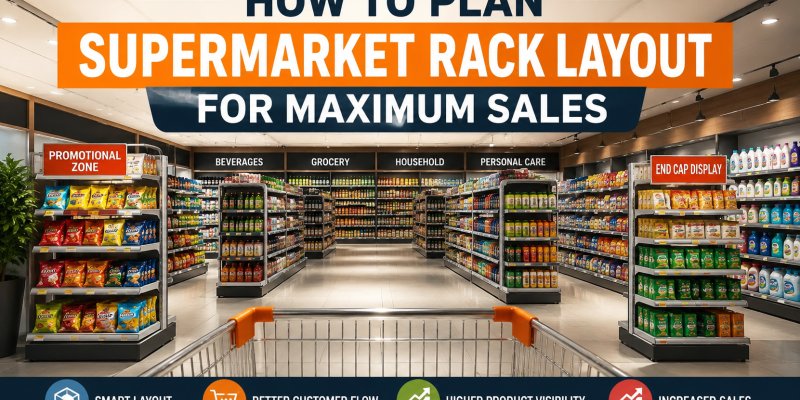
For more detailed planning, see the supermarket rack layout for maximum sales guide.
You can also explore supermarket rack design ideas before finalising your store layout.
Supermarket Rack Layout: How to Use Your Space Properly
A supermarket layout should balance maximum merchandise visibility with comfortable customer movement.
A common arrangement is:
Walls → Wall-mounted racks
Centre → Gondola racks
Aisle ends → End-cap displays
Entrance → Promotional displays
Billing area → Impulse products
The exact arrangement should be adjusted according to your store dimensions and product categories.
For example, frequently purchased grocery categories can be arranged so customers can easily find them, while promotional and impulse products can be placed in high-visibility areas.
A good rack layout is not just about fitting more products into the store. It is about making the products easier to see, compare and purchase.
If you are still deciding between different layouts, the article on how to choose the right supermarket racks for your store can help you make the decision based on store requirements rather than appearance alone.
What Other Equipment Does a Supermarket Need?
Display racks are only one component of the setup.
Billing Counter and POS
A supermarket generally needs:
- POS computer
- Billing software
- Barcode scanner
- Receipt printer
- Cash drawer
- Weighing machine
- UPS or backup power
Larger stores may require multiple counters.
Refrigeration
Depending on your product range, you may need:
- Beverage coolers
- Deep freezers
- Dairy chillers
- Frozen-food freezers
- Refrigerated displays
Shopping Trolleys and Baskets
Small supermarkets may mainly require baskets, while larger stores generally need a combination of baskets and trolleys.
CCTV
CCTV should cover the entrance, billing area, aisles and important product sections.
Lighting
Good lighting improves product visibility and makes the store feel more organised.
Signage
Category signage helps customers quickly identify areas such as:
Grocery | Beverages | Snacks | Personal Care | Household | Dairy
Grocery Store vs Supermarket: Is the Setup Cost Different?
Yes.
A grocery store generally operates with a smaller footprint and may focus on essential products, while a supermarket typically provides a wider product range, more structured aisles and a larger shopping environment.
For a smaller grocery business, shelving may need to prioritise maximum storage in limited space.
For example, you can explore grocery store shelving ideas when planning a compact store.
You can also use the choose best grocery display rack guide when comparing different shelving options.
For a larger supermarket, the focus shifts toward:
Product display + customer movement + category organisation + promotional merchandising
Kirana Store vs Supermarket Rack Requirements
A kirana store and a supermarket may sell many of the same product categories, but their shelving requirements can be quite different.
A kirana store often needs to maximise storage within a relatively small space, while a supermarket needs to create a customer-friendly shopping environment.
If you are planning a smaller grocery/kirana format, compare the requirements with these kirana store rack designs and the kirana display rack price guide.
The right choice depends on your:
- Store size
- Product categories
- Available wall space
- Product weight
- Customer movement
- Storage requirements
How to Reduce Supermarket Setup Cost Without Compromising the Store
A lower startup budget does not necessarily mean you have to compromise on the customer experience.
The key is to spend money where it creates practical value.
Plan the Layout Before Buying Racks
This is one of the easiest ways to avoid unnecessary spending.
A proper layout can tell you exactly how many rack bays you need.
Buying extra racks that remain unused ties up capital.
Compare Quotations on Specifications, Not Just Price
Suppose Supplier A quotes ₹2 lakh and Supplier B quotes ₹2.3 lakh.
The cheaper option is not automatically better.
Compare:
- Material
- Dimensions
- Shelf thickness
- Load capacity
- Finish
- Quantity
- Accessories
- Delivery
- Installation
Only then compare the total project price.
Start With Important Product Categories
Do not necessarily fill the store with every possible SKU on day one.
Focus on products with strong local demand and gradually expand your assortment.
Keep Working Capital Separate
Your business still has expenses after opening.
You need money for:
- Rent
- Salaries
- Electricity
- Restocking
- Repairs
- Marketing
- Unexpected expenses
Common Mistakes When Setting Up a Supermarket
Starting a supermarket involves many decisions, and small planning mistakes can become expensive after the store opens.
Buying the Cheapest Racks
The lowest quotation should not automatically win.
Racks should be evaluated according to their intended load, dimensions, construction and expected usage.
Filling the Store With Too Many Racks
More racks do not always mean more sales.
If aisles become narrow, customers may find the store uncomfortable.
Spending Too Much on Interiors
A premium-looking interior is useful, but it should not consume money needed for inventory and working capital.
Ignoring Product Placement
A supermarket needs logical category planning.
Customers should be able to understand where products are located.
Not Planning Storage
Not every product needs to remain on the selling floor.
Back-end storage can help maintain cleaner displays and improve replenishment.
Buying Before Measuring
Never finalise rack quantities without measuring the actual usable store area.
For a deeper explanation, read the top mistakes to avoid when buying supermarket display racks.
How Much Working Capital Should You Keep?
One of the most overlooked parts of supermarket planning is working capital.
Opening the store is only the beginning.
For the first few months, you may need funds for:
- Rent
- Salaries
- Electricity
- Inventory replenishment
- Maintenance
- Marketing
- Packaging
- Unexpected expenses
If you spend almost all your capital on inventory and interiors, you may face cash-flow pressure immediately after opening.
A practical approach is to divide your available investment into:
Setup Investment + Inventory + Working Capital Reserve
This gives the business some breathing room while sales and customer demand stabilise.
Is Starting a Supermarket Profitable in India?
A supermarket can be profitable, but profitability depends on the business model rather than store size alone.
Important factors include:
- Location
- Customer footfall
- Product mix
- Gross margins
- Supplier terms
- Inventory turnover
- Rent
- Staff cost
- Electricity
- Wastage
- Customer retention
A store with high sales can still have poor profitability if operating costs and inventory losses are not controlled.
Therefore, before investing, prepare a simple business model covering:
Expected monthly sales → Gross margin → Rent → Salaries → Electricity → Inventory replenishment → Other operating expenses
This gives you a more realistic picture than looking at sales alone.
How a Good Rack Layout Can Support Sales
A supermarket rack is not simply a storage structure.
The way products are presented can affect:
- Product visibility
- Category navigation
- Customer movement
- Promotional visibility
- Impulse buying opportunities
- Available selling space
This is why rack planning should happen before the final interior work.
You can also read about how display racks boost sales to understand why product presentation matters beyond storage.
For businesses considering a customised store layout, the guide to custom display racks in Delhi can also help explain when standard shelving may not be sufficient.
Supermarket Setup Checklist Before Opening
Before opening the store, review the following areas:
Property
- Location
- Rent
- Security deposit
- Parking
- Accessibility
Interior
- Flooring
- Lighting
- Electrical work
- Ceiling
- Signage
Display
- Wall racks
- Center racks
- End caps
- Promotional displays
- Storage
Technology
- POS
- Barcode scanner
- Billing printer
- Inventory software
- CCTV
Customer Experience
- Shopping baskets
- Trolleys
- Clear aisles
- Category signage
Inventory
- Supplier network
- Initial stock
- Pricing
- Reordering system
Operations
- Staff
- Registrations/licences
- Working capital
- Marketing
Frequently Asked Questions About Supermarket Setup Cost in India
How much does it cost to start a supermarket in India?
The approximate investment can start from ₹5 lakh for a small supermarket and can exceed ₹50 lakh for a large supermarket. A 1,000–2,000 sq. ft. supermarket may typically require around ₹10–25 lakh+, depending on rent, interiors, racks, inventory, equipment and working capital.
What is the supermarket setup cost for 1,000 sq. ft.?
A 1,000 sq. ft. supermarket may require approximately ₹5–15 lakh+. Property cost, initial inventory and rack requirements are among the biggest variables.
What is the supermarket setup cost for 2,000 sq. ft.?
A 2,000 sq. ft. supermarket may require approximately ₹10–25 lakh+, although the actual cost can be higher depending on location, product range and infrastructure.
How much does a supermarket display rack cost?
There is no fixed price because rack cost depends on dimensions, material, shelf quantity, load capacity, finish and customisation. The number of rack bays required also affects the total project cost.
For a complete project, it is better to request a quotation based on your store size rather than relying on a generic per-rack price.
Which display racks are best for a supermarket?
A combination of wall-mounted racks, center gondola racks and end-cap display racks is commonly suitable for supermarkets. The final selection should depend on store size, product categories, load requirements and customer movement.
How many racks are required for a supermarket?
There is no standard number. Rack quantity should be calculated after considering the store’s usable floor area, aisle width, rack dimensions, product categories and storage requirements.
How can I reduce supermarket setup cost?
You can control startup costs by planning the layout before buying racks, comparing suppliers based on specifications, avoiding unnecessary interior expenses, controlling initial inventory and maintaining a working-capital reserve.
Are MS supermarket racks suitable for grocery stores?
Yes. MS supermarket racks can be suitable for grocery stores when the rack specifications, shelf configuration and load capacity are selected according to the products being displayed.
Should I buy supermarket racks online or directly from a manufacturer?
For a complete supermarket setup, purchasing directly from a manufacturer can make it easier to discuss store dimensions, rack quantities, customisation, load capacity, delivery and installation.
How should supermarket racks be arranged?
A common arrangement is to use wall-mounted racks along the walls, gondola racks in the centre and end-cap racks at aisle ends. The final layout should maintain comfortable customer movement and logical product categorisation.
What equipment is required for a supermarket?
Common supermarket equipment includes display racks, billing counters, POS systems, barcode scanners, refrigeration units, shopping trolleys, baskets, CCTV, weighing machines and storage equipment.
Is a supermarket business profitable in India?
A supermarket can be profitable when it has strong local demand, effective inventory management, competitive pricing, good supplier relationships and controlled operating expenses. Profitability varies by location, product mix and operating costs.
Where can I buy supermarket display racks in Delhi?
Businesses looking for supermarket display racks manufacturer in Delhi can contact Bharat Display Solutions to discuss store size, rack requirements, configurations and project-specific quotations.
Planning Your Supermarket? Start With the Rack Layout
If you are opening a supermarket, don’t wait until the last stage to think about display racks.
Your rack selection affects the way the store is divided, how products are displayed and how customers move through the shopping area.
A better process is:
Store measurement → Layout planning → Rack selection → Rack quantity → Interior execution → Product placement
If you already know your store size, you can start discussing the required rack configuration before ordering.
For a Delhi-based project, you can contact Bharat Display Solutions to discuss supermarket rack requirements, configurations and project-specific solutions.
If you need a local supplier, the display rack manufacturer in Delhi page is another relevant commercial resource.
Get Supermarket Display Racks for Your Store
Starting a supermarket requires careful planning of both investment and store inThe right supermarket rack is not necessarily the cheapest rack.
It should be the rack that matches your:
- Store size
- Product categories
- Shelf load requirements
- Available floor area
- Customer movement
- Budget
- Future expansion plans
If you are planning a new supermarket, share your store dimensions, location and approximate product categories with the manufacturer. This makes it easier to discuss the number and type of racks required instead of purchasing standard units without considering the complete store.
Ready to Plan Your Supermarket?
Get a supermarket rack quotation from Bharat Display Solutions
You can discuss your store requirements and determine a suitable combination of wall-mounted, center and end-cap display racks for your supermarket.
Final Conclusion
TThe supermarket setup cost in India in 2026 can range from approximately ₹5 lakh for a small supermarket to ₹50 lakh or more for a large-format store, while stores above 5,000 sq. ft. can require ₹50 lakh–₹1 crore or more depending on their location, inventory and infrastructure.
The major investment areas are:
Property + Interiors + Display Racks + Equipment + Inventory + Technology + Working Capital
Among these, display racks deserve particular attention because they are not just storage equipment. They influence how much merchandise can be displayed, how customers move through the store and how effectively different product categories can be presented.
The best approach is therefore to calculate your supermarket setup cost as a complete project rather than treating each expense separately.
Start with the store size, understand your target customer, plan the rack layout, calculate the equipment and inventory requirements, and keep sufficient working capital for the months after opening.
With the right combination of budget planning, store layout, product selection and display shelving, you can build a supermarket that is not only visually organised but also practical for day-to-day retail operations.
If your next step is planning the actual shelving, contact Bharat Display Solutions for supermarket display rack requirements and discuss your store size and project needs before finalising the rack quantity.